


Overview
Incompressible Pipe Flow Analysis & System Modeling Software
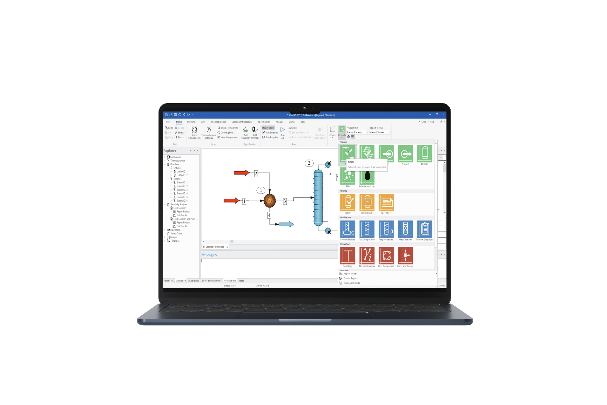
Fathom™ by Datacor : an intuitive visual platform for modeling incompressible flow in pipe networks that brings increased productivity to the pipe flow engineer by simplifying the pipe network modeling process, combining drag-and-drop modeling with traditional engineering hydraulic analysis.
Fathom can show both input data and analysis results in visual form, allowing rapid analysis of a model’s validity. Fathom’s intuitive graphical environment accelerates the identification of erroneous assumptions, typographic and modeling errors as well as re-running models, all with the click of a cursor.
Whether you need to evaluate and improve an existing system or design a new one, Fathom greatly improves productivity in the modeling process.

Visual Modeling
Quickly build, view, and validate complex pipe networks—all in a single intuitive graphical environment
Scenario Manager
Track and compare multiple design or operating cases within one file, enabling rapid “what‑if” comparisons
Cost & Energy Analysis
Automated Network Sizing calculates capital costs (pipes, components) or ongoing energy use to help optimize designs for both initial budget and lifecycle efficiency
Advanced Fluid Modeling
Supports complex fluids and systems—including non‑Newtonian slurries, variable‑speed pumps, heat transfer, and goal‑seeking controls—making it ideal for rigorous engineering applications
What can Fathom do?
Fathom can be used to model a wide variety of incompressible flow systems, including :
- Open and closed (recirculating) systems
- Network systems that branch or loop, with no limit on the number of loops
- Pressure fed systems and gravity fed systems
- Pumped systems, including multiple pumps in parallel or in series
- Pumps with variable speed, controlled pressure, controlled flow, and viscosity corrections
- Systems with pressure and/or flow control valves
- Systems with valves closed and pumps turned off
- Heat Transfer and system energy balance
- Systems with variable density and viscosity
- Multiple design cases in a single model file (Scenario Manager)
- Non-Newtonian fluid behavior
- Cost calculation of pump energy usage
Fathom includes many standard loss models for pipe system components, but also allows you to enter your own data. Variable loss models that depend on flow are supported.
Fathom’s powerful solution engine is based on benchmark methods used over many years in industry. The Newton-Raphson method is used to solve the fundamental equations of pipe flow that govern mass and momentum balance. Solutions are obtained by iteration, and matrix methods optimized for speed are employed to obtain convergence.
Who can use Fathom?
The user should possess a good general knowledge of engineering pipe system hydraulics, consistent with that obtained in a typical engineering undergraduate course in fluid mechanics. Even the most advanced and easy-to-use software package can’t compensate for a lack of fundamental knowledge on the part of the user.
Innovations
Fathom Highlights
Lorem ipsum dolor sit amet, cons ectetuer adipiscing elit, sed diam nonummy nibh euismod tincidunt ut laoreet dolore magna aliquam erat volutpat ut wisi enim ad minim veniam.

Fathom Highlights
Parametric Study Tool
The Parametric Study tool enables rapid and in-depth simulation analysis, allowing users to explore a wide range of input parameters efficiently. By systematically varying inputs, the tool helps identify critical factors affecting system performance, enhancing sensitivity analysis and optimization. Engineers can gain clear insights through graphical trends, even in cases where traditional goal-seeking methods struggle. This approach facilitates better decision-making by providing visual justifications for key trade-offs, such as cost versus performance.
Fathom Highlights
Graph Annotations
Graph Annotations is a new feature designed to enhance modeling workflows by allowing users to add auto-updating graphs directly to their Workspace. These graphs provide instant insights by visually comparing model results without requiring users to navigate elsewhere. Fully resizable, movable, and easily hidden, they function like Color Map layers, updating automatically based on Output data. By bringing the capabilities of the Graph Results tab to the Workspace, this provides a streamlined approach to reviewing key data, improving efficiency and decision-making.
Fathom Highlights
Scenario Comparison Layer
The Scenario Comparison Layer enhances clarity in scenario analysis by visually highlighting differences between the current scenario and a selected comparison scenario, whether explicitly chosen or related by one degree (Parent, Sibling, or Child). Objects with differences are color-coded on the Workspace, allowing users to quickly identify differences between the scenarios.
Fathom Highlights
Cross-App Heat Exchanger Thermal Link
The new Cross-App Heat Exchanger Thermal Link feature in Fathom and Arrow streamlines the thermal analysis of liquid-gas heat exchangers by allowing direct thermal connections between heat exchanger junctions in gas (Arrow) and liquid (Fathom) systems. This integration enables both applications to run simultaneously until a converged solution is reached, eliminating the need for manual iterations. By automating this process, users can significantly reduce errors, complexity, and the time spent on iterative adjustments.
Add-on modules
Fathom add-on Modules
Fathom has several Add-on Modules that extend modeling capabilities, which can be used individually or combined.
Extended Time Simulation (XTS) module
The Extended Time Simulation (XTS) module for modeling time varying system behavior.
- Pump starting and stopping over time
- Valve opening and closing over time
- Tank liquid level changes automatically calculated
Goal Seek & Control (GSC) module
Allows the engineer to perform multi-variable goal seeking and simulate control system functions.
Settling Slurry (SSL) module
Allows the engineer to perform the complex property and system interaction calculations associated with settling slurry flows.
- Modeling of homogeneous and pseudo-homogeneous slurry mixtures
- Slurry pump performance derating
Automated Network Sizing (ANS) module
Automates the process of sizing pipes and ducts in a complex network based on required conditions, such as maximum pressure or minimum flow, to reduce cost, weight, or both.